Diploma Programme

Diploma Programme

Book a Tour

IB Diploma Students
 

International Baccalaureate Diploma Programme


The IB Diploma Programme is a challenging, broad-based two-year pre-university curriculum, primarily aimed at students aged 16 to 19. It leads to a qualification (the IB diploma) that is widely recognized by the world’s leading universities.

It is of utmost importance that students learn to manage their time well in order to cope with the demands of the course and maintain high standards. Applying good time management skills must begin in the first year of the programme and be perfected in the second year to enable students to reach their potential and enjoy their learning.

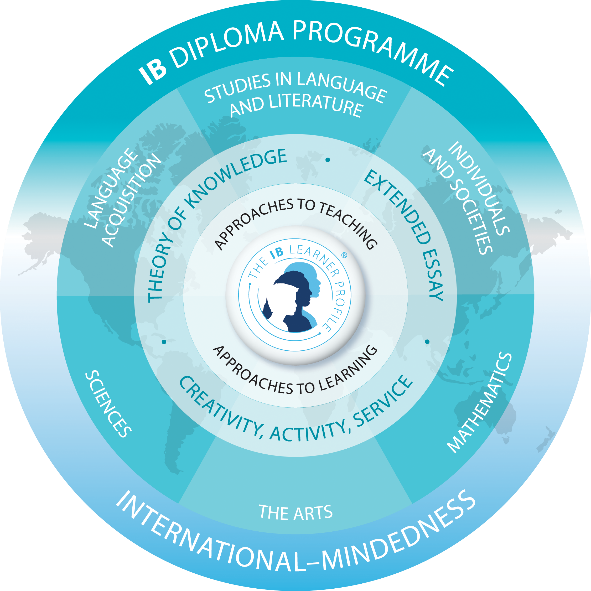
The curriculum contains six subject groups together with the DP core: creativity, activity, service (CAS); the extended essay (EE); and theory of knowledge (TOK). This is illustrated by the Diploma Programme model, with the learner situated in the centre.

Candidates studying for the diploma select six subjects from the various subject groups.

One subject must be selected from five different subject groups:

  • Studies in Language & Literature (Group 1)
  • Language Acquisition (Group 2)
  • Individuals & Societies (Group 3)
  • Sciences (Group 4)
  • Mathematics (Group 5)

The sixth subject may be selected from Group 6, Visual Arts or Theatre, or a second subject from Group 2, 3 or 4. Normally three subjects are studied at higher level (HL = 240 teaching hours), and the remaining three subjects are studied at standard level (SL = 150 teaching hours).

ibdp diagram

International Baccalaureate Diploma Programme


The IB Diploma Programme is a challenging, broad-based two-year pre-university curriculum, primarily aimed at students aged 16 to 19. It leads to a qualification (the IB diploma) that is widely recognized by the world’s leading universities.

It is of utmost importance that students learn to manage their time well in order to cope with the demands of the course and maintain high standards. Applying good time management skills must begin in the first year of the programme and be perfected in the second year to enable students to reach their potential and enjoy their learning.

The curriculum contains six subject groups together with the DP core: creativity, activity, service (CAS); the extended essay (EE); and theory of knowledge (TOK). This is illustrated by the Diploma Programme model, with the learner situated in the centre.

Candidates studying for the diploma select six subjects from the various subject groups.

One subject must be selected from five different subject groups:

  • Studies in Language & Literature (Group 1)
  • Language Acquisition (Group 2)
  • Individuals & Societies (Group 3)
  • Sciences (Group 4)
  • Mathematics (Group 5)

The sixth subject may be selected from Group 6, Visual Arts or Theatre, or a second subject from Group 2, 3 or 4. Normally three subjects are studied at higher level (HL = 240 teaching hours), and the remaining three subjects are studied at standard level (SL = 150 teaching hours).

Assessment and the IB Diploma

Assessment and the IB Diploma


At the end of the two-year programme, IBDP candidates are assessed both internally and externally. They receive grades ranging from 7 to 1, with 7 being the highest. Students receive a grade for each of the six DP courses attempted.

A student’s final Diploma result score is made up of the combined scores for each subject. The diploma is awarded to students who gain at least 24 points, subject to certain minimum levels of performance including successful completion of the three essential elements of the DP core.

Assessment and grading

Bilingual Diploma Award


A bilingual diploma is awarded to a successful candidate who fulfils one or both of the following criteria:

Completion of two languages selected from Group 1 with the award of a grade 3 or higher in both.

Completion of one of the subjects from Group 3 or Group 4 in a language that is not the same as the candidate’s nominated Group 1 language. The candidate must attain a grade 3 or higher in both the Group 1 language and the subject from Group 3 or 4.

DP Subjects


Explore each subject offered in the IB Diploma Programme, arranged by IB subject group.

Introduction

The IB Diploma Programme, (Language and Literature) is taught over a period of two years with students studying texts from different times and continents. These courses are designed to support future academic study or career-related paths by developing social, aesthetic and cultural literacy, as well as improving language competence and communication skills. There is a combination of both written and oral examinations. Students study a variety of genres and sit two papers for their final exams. It is an enriching programme which enables students to understand human strengths and weaknesses.

Main Objectives of Language and Literature — Know, understand and interpret:

  • A range of texts, works and/or performances, and their meanings and implications
  • Contexts in which texts are written and/or received
  • Elements of literary, stylistic, rhetorical, visual and/or performance craft
  • Features of particular text types and literary forms.

Analyse and evaluate:

  • Ways in which the use of language creates meaning
  • Uses and effects of literary, stylistic, rhetorical, visual or theatrical techniques
  • Relationships among different texts
  • Ways in which texts may offer perspectives on human concerns.

Communicate:

  • Ideas in clear, logical and persuasive ways
  • In a range of styles, registers and for a variety of purposes and situations

In practice

A Year 12 English Language and Literature student studying Colonialism will look at plays such as The Dreamers by Davis. Set in Australia, the main character battles with post-colonial life. Through the study of this play, students will explore features such as appropriating the colonial language, rewriting history, struggles of decolonisation and cultural identity.

Students will also undertake post-colonial readings of non-Literary texts such as adverts showcasing Delightful Durban and will explore how power is exerted through language and the ways some people are given a voice while others are silenced within a text.

A Year 12 French Language and Literature student studying the unit ‘La santé, le monde et moi…’ will analyse Moliere’s “Le Malade imaginaire” (1673) and discuss to what extent Argan is hypochondriac and the impact of this condition on his family. Students also read and analyse “Moi, l’interdite” by Ananda Devi to delve in discussions on mental health. Non-literary texts will consist of articles and short videos focusing on the Covid-19 sanitary crisis.

Northfields also offers students the opportunity to study the literature of a language that may not be offered at our school as a taught subject. Students are expected to work independently under the guidance of the SSRT supervisor. You will also need a tutor in your first or best language to assist you throughout the course, which will be at an additional cost. The tutor will be particularly helpful when you start preparing for the assessment components and need feedback on your work. For example, you will be asked to develop a list of nine literary works and a timeline together with your tutor. You will also be expected to autonomously administer the 150 hours required for the study of the course.

The aims and objectives of the course remain the same as the Language and Literature DP programme, where you will engage with nine works overall, written by authors on the Prescribed reading list.

Language B is a language acquisition course designed for students with some previous experience of the target language. In the language B course, students further develop their ability to communicate in the target language through the study of language, themes and texts. In doing so, they also develop conceptual understandings of how language works, as appropriate to the level of the course. English language B is offered at SL (Standard level) and HL (Higher level).

Main aims of Language acquisition

  1. Develop international mindedness through the study of languages, cultures, and ideas and issues of global significance.
  2. Enable students to communicate in the language they have studied in a range of contexts and for a variety of purposes.
  3. Encourage, through the study of texts and through social interaction, an awareness and appreciation of a variety of perspectives of people from diverse cultures.
  4. Develop students’ understanding of the relationship between the languages and cultures with which they are familiar.
  5. Develop students’ awareness of the importance of language in relation to other areas of knowledge.
  6. Provide students, through language learning and the process of inquiry, with opportunities for intellectual engagement and the development of critical- and creative-thinking skills.
  7. Provide students with a basis for further study, work and leisure through the use of an additional language.
  8. Foster curiosity, creativity and a lifelong enjoyment of language learning.

Main Objectives

  1. Communicate clearly and effectively in a range of contexts and for a variety of purposes.
  2. Understand and use language appropriate to a range of interpersonal and/or intercultural contexts and audiences.
  3. Understand and use language to express and respond to a range of ideas with fluency and accuracy.
  4. Identify, organize and present ideas on a range of topics.
  5. Understand, analyse and reflect upon a range of written, audio, visual and audio-visual texts.

The English B course, like other language acquisition courses, is designed for students with some previous or developing experience of the target language. Students further develop their ability to communicate through the study of language, themes, and literary texts. There are five prescribed themes: identities, experiences, human ingenuity, social organization and sharing the planet. Both language B SL and HL students learn to communicate in the target language in familiar and unfamiliar contexts.

The curriculum is organised around the five prescribed themes with which the students engage through written, audio, visual and audio-visual texts. Students develop into successful, effective communicators by considering the conceptual understandings of context, audience, purpose, meaning and variation. Communication is evidenced through receptive, productive and interactive skills. Many of the topics studied engage students in current and topical affairs. A willingness to expand one’s knowledge and interest in a variety of topics is a must!

The English B course fosters curiosity, creativity, and a lifelong enjoyment of language learning. It provides students, through language learning and the process of inquiry, with opportunities for intellectual engagement and the development of critical and creative thinking skills.

When preparing for the IB Diploma, all students are expected to study at least two languages. Students can study French in groups 1 or 2: French A, French B or French Ab initio. Students who study French in group 1 – français A langue et littérature – are awarded a bilingual diploma.

Language B is a language acquisition course designed for students with some previous experience of the target language. In the language B course, students further develop their ability to communicate in the target language through the study of language, themes and texts. French language B is offered at SL (Standard level) and HL (Higher level).

What it looks like in practice

In Year 12 & 13, the teaching of French B continues to develop knowledge of vocabulary and grammar, as well as conceptual understanding of how language works, in order to construct, analyse and evaluate arguments on a variety of topics relating to course content and the target language culture(s). We study 5 themes alongside some works of literature in preparation for the oral assessment. The themes provide relevant contexts for study at all levels of language acquisition in the DP, and opportunities for students to communicate about matters of personal, local or national, and global interest.

For instance, we look at the theme Human Ingenuity, which is to explore how human creativity and innovation affects our world. The language B course is to develop international mindedness through the study of language, culture, ideas, and issues of global significance.

When preparing for the IB Diploma, all students are expected to study at least two languages. Students can study French in groups 1 or 2: French A, French B or French Ab initio.

Ab Initio French is a language acquisition course designed for beginner level students or students with little previous experience of the target language. In the Ab initio course, students develop their ability to communicate in the target language through the study of language, themes and texts.

What it looks like in practice

In Year 12 & 13, the teaching of French Ab initio develops knowledge of vocabulary and grammar, as well as conceptual understanding of how language works, in order to construct, analyse and evaluate arguments on a variety of topics relating to course content and the target language culture(s). We study 5 themes in preparation for the oral assessment. The themes provide relevant contexts for study in language acquisition in the DP, and opportunities for students to communicate about matters of personal, local or national, and global interest. For instance, we look at the theme Human Ingenuity, which is to explore how human creativity and innovation affects our world.

When preparing for the IB Diploma, all students are expected to study at least two languages. Students can study Spanish as well as one other language.

Ab Initio Spanish is a language acquisition course designed for beginner level students or students with little previous experience of the target language. In the Ab initio course, students develop their ability to communicate in the target language through the study of language, themes and texts.

Main Objectives — Ab initio

  • Communicate clearly and effectively in a range of contexts and for a variety of purposes.
  • Understand and use language appropriate to a range of interpersonal and/or intercultural contexts and audiences.
  • Understand and use language to express and respond to a range of ideas with fluency and accuracy.
  • Identify, organize and present ideas on a range of topics.
  • Understand, analyse and reflect upon a range of written, audio, visual and audio-visual texts.

What it looks like in practice

In Year 12 & 13, the teaching of Spanish Ab initio develops knowledge of vocabulary and grammar, as well as conceptual understanding of how language works, in order to construct, analyse and evaluate arguments on a variety of topics relating to course content and the target language culture(s). We study 5 themes in preparation for the oral assessment.

History is a dynamic, contested, evidence-based discipline that involves an exciting engagement with the past. It is a rigorous intellectual discipline, focused around key historical concepts such as change, causation and significance. Studying history develops an understanding of the past, which leads to a deeper understanding of the nature of humans and of the world today.

The IB Diploma Programme (DP) history course is a world history course based on a comparative and multiperspective approach to history. It involves the study of a variety of types of history, including political, economic, social and cultural, and provides a balance of structure and flexibility. The course emphasizes the importance of encouraging students to think historically and to develop historical skills as well as gaining factual knowledge.

Aims

  • Develop an understanding of, and continuing interest in, the past
  • Encourage students to engage with multiple perspectives and to appreciate the complex nature of historical concepts, issues, events and developments
  • Promote international-mindedness through the study of history from more than one region of the world
  • Develop an understanding of history as a discipline and to develop historical consciousness including a sense of chronology and context
  • Develop key historical skills, including engaging effectively with sources
  • Increase students’ understanding of themselves and of contemporary society by encouraging reflection on the past.

Assessment objectives

  • AO1 Knowledge and understanding — demonstrate detailed, relevant and accurate historical knowledge; understanding of historical concepts and context; understanding of historical sources.
  • AO2 Application and analysis — formulate clear and coherent arguments; use relevant historical knowledge to support analysis; analyse and interpret a variety of sources.
  • AO3 Synthesis and evaluation — integrate evidence and analysis; evaluate different perspectives; evaluate sources as historical evidence; synthesize information.
  • AO4 Use and application of skills — structure focused essays; reflect on methods and challenges; formulate a focused inquiry question; demonstrate research, organisation and referencing skills.

Topics — SL and HL

  • Rights and protest — struggles for rights and freedoms in the mid-20th century, with case studies on the US civil rights movement (1954–1965) and protests against apartheid in South Africa (1948–1964).
  • The Cold War: superpower tensions and rivalries — how rivalries changed with leadership, ideology, economics and crises, from more than one region of the world.
  • Authoritarian states — conditions that facilitated the rise of authoritarian states in the 20th century and how power was taken and maintained.

Internal assessment — a historical investigation into a topic of the student’s choice, identical for SL and HL.

HL topics

  • The French Revolution and Napoleon I (1774–1815).
  • Imperial Russia, revolution and the establishment of the Soviet Union (1855–1924).
  • The Soviet Union and post-Soviet Russia (1924–2000).

The business management course is designed to meet the current and future needs of students who want to develop their knowledge of business content, concepts and tools to assist with business decision-making. Future employees, business leaders, entrepreneurs or social entrepreneurs need to be confident, creative and compassionate as change agents for business in an increasingly interconnected global marketplace.

Through the exploration of four interdisciplinary concepts—creativity, change, ethics and sustainability—this course empowers students to explore these concepts from a business perspective. Business management focuses on business functions, management processes and decision-making in contemporary contexts of strategic uncertainty.

Students examine how business decisions are influenced by factors internal and external to an organization and how these decisions impact stakeholders. Emphasis is placed on strategic decision-making and the operational business functions of human resource management, finance and accounts, marketing, and operations management.

The business management course encourages the application of local, national and global examples to content and concepts; the internal assessment (IA) for both SL and HL is an individual business research project.

Aims

  • Develop as confident, creative and compassionate business leaders, entrepreneurs, social entrepreneurs and as change agents
  • Foster an informed understanding of ethical and sustainable business practices
  • Explore the connections between individuals, businesses and society
  • Engage with decision-making as a process and a skill.

SL vs HL

  • Recommended hours: 150 hours SL vs 240 hours HL
  • Extra depth and breadth (extension material for HL only)
  • Nature of paper 2 and paper 3 examination questions

Paper 3 is an HL-only paper based on a social enterprise, where students identify a human need and organizational challenges and write a decision-making document with a business recommendation.

The Diploma Economics Programme is a rigorous pre-university course designed for students in the 16 to 19 age range. It aims to encourage students to be knowledgeable, inquiring, caring and compassionate. The course promotes international-mindedness and explores economics within a global context.

While economics has its foundations in theory, the course places emphasis on the application of economic theory to real-world issues. By examining economic issues and policy interventions at local, national and global levels, students are empowered to use their knowledge to seek solutions to issues that matter to them. Economics provides students with the analytical tools necessary to develop a deep understanding of major global challenges dealing with equity, sustainability, the concentration of economic power and increasing interdependence.

SL vs HL

  • Recommended hours: 240 hours HL vs 150 hours SL
  • Extra depth and breadth (extension material for HL only)
  • Nature of examination questions — HL Paper 3 assesses further quantitative skills for informed policy advice.

Focus areas

  • Microeconomics — producers and consumers in individual markets.
  • Macroeconomics — the government and the national economy.
  • The global economy — international trade and the movement of labour and capital.

Geography is a dynamic subject grounded in the real world and focuses on the interactions between individuals, societies and physical processes in both time and space. It seeks to identify trends and patterns, investigates how people adapt to change, and evaluates management strategies associated with such change.

The Diploma Programme geography course integrates physical, environmental and human geography, and ensures that students acquire both socio-economic and scientific methodologies. It develops life skills and an appreciation for alternative approaches, viewpoints and ideas.

Aims

  • Develop an understanding of the dynamic interrelationships between people, places, spaces and the environment at different scales
  • Develop a critical awareness and consider complexity thinking in the context of geographic issues, including how “wicked problems” have been shaped and could be resolved
  • Understand and evaluate the need for planning and sustainable development through the management of resources at varying scales.

Assessment objectives

  • Demonstrate knowledge and understanding of specified content.
  • Demonstrate application and analysis of knowledge and understanding.
  • Demonstrate synthesis and evaluation.
  • Select, use and apply a variety of appropriate skills and techniques.

SL vs HL

  • SL students study two optional themes; HL students study three optional themes.
  • Both SL and HL study the core geographic perspectives — global change.
  • HL students additionally study global interactions and further synthesize prescribed concepts.
  • Both SL and HL complete a fieldwork study for the internal assessment.

IBDP ITGS covers the widespread use of IT and raises important questions about social and ethical issues that shape our society today. It offers a systematic study of these issues, whose range falls outside the scope of any other single discipline. The course covers social and ethical issues, IT systems in a social context, hardware requirements, software applications, communication systems and integrated systems such as robotics and artificial intelligence. All areas are linked to impacts of IT on business and employment, education, health, arts, entertainment and leisure, science and the environment, politics and government.

Main aims

  • Demonstrate an awareness of IT applications and developments in specified scenarios.
  • Demonstrate an awareness of the social and ethical significance of specified IT applications and developments.
  • Demonstrate technical knowledge of ITGS terminology, concepts and tools.
  • Demonstrate technical knowledge of IT systems.
  • Explain the impacts of IT applications and developments in specified scenarios.
  • Analyze the social and ethical significance of specified IT applications and developments.
  • Transfer IT knowledge and make connections between specific scenarios.
  • Evaluate local and global impacts of specified IT developments through individually researched studies.
  • Evaluate a solution involving IT to a specified problem using knowledge of IT systems.
  • Discuss the social and ethical implications of specified IT policies and developments.
  • Demonstrate evidence of project management in the development of a well-organized product.
  • Use IT tools and the product development life cycle (PDLC) to create an original product in consultation with a client.

Main objectives

  • Enable students to evaluate social and ethical considerations arising from the widespread use of IT at local and global levels.
  • Develop understanding of the capabilities of current and emerging IT systems and evaluate their impact on stakeholders.
  • Apply knowledge of existing IT systems to various scenarios and make informed judgements.
  • Use knowledge of IT systems and practical skills to justify IT solutions for a specified client or end-user.

The systems approach provides the core methodology of the Environmental Systems and Societies (ESS) course. It is complemented by other influences, such as economic, historical, cultural, socio-political, and scientific factors, to provide a holistic perspective on environmental issues. During the course, students will look at examples on a variety of scales, from local to global, and in an international context.

Main aims

  • Acquire the knowledge and understandings of environmental systems at a variety of scales.
  • Apply the knowledge, methodologies, and skills to analyze environmental systems and issues at a variety of scales.
  • Appreciate the dynamic interconnectedness between environmental systems and societies.
  • Value the combination of personal, local, and global perspectives in making informed decisions and taking responsible actions.
  • Be critically aware that resources are finite and that management of inequities is the key to sustainability.
  • Develop awareness of the diversity of environmental value systems.
  • Develop critical awareness that environmental problems are caused and solved by decisions made by individuals and societies.
  • Engage with the controversies that surround a variety of environmental issues.
  • Create innovative solutions to environmental issues by engaging actively in local and global contexts.

Topics (two academic years)

  • Topic 1 — Foundations of environmental systems and societies
  • Topic 2 — Ecosystems and ecology
  • Topic 3 — Biodiversity and conservation
  • Topic 4 — Water and aquatic food production systems and societies
  • Topic 5 — Soil systems and terrestrial food production systems and societies
  • Topic 6 — Atmospheric systems and societies
  • Topic 7 — Climate change and energy production
  • Topic 8 — Human systems and resource use

Fieldwork may be based on local ecosystems. Students are taught over 2 academic years, with 3 hours of teaching per week plus homework. The tuition involves tutorial lessons, laboratory activities, fieldwork, group and peer learning, presentation giving and self-study.

Offered at Standard Level — Environmental Systems and Societies is currently available only at SL. It is not an “easy option”: the course is multidisciplinary, appropriately challenging and rewarding.

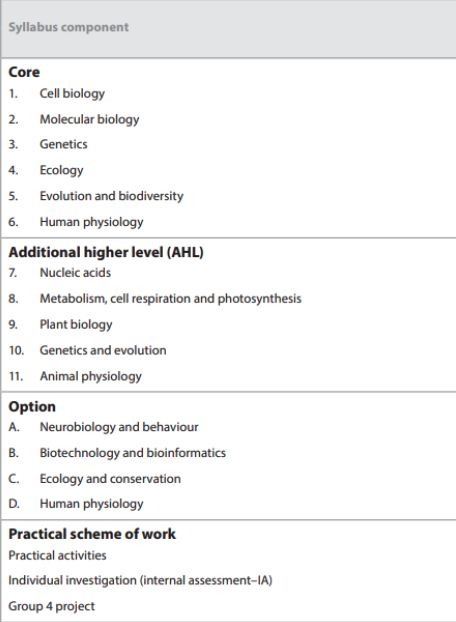
Biology is the study of life. There have been at least five periods when very large numbers of species became extinct and biologists are concerned that another mass extinction is under way, caused this time by human activity. Biologists attempt to understand the living world at all levels using many different approaches and techniques — from cells and molecular reactions to whole ecosystems.

Biology is a young science and great progress is expected in the 21st century, at a time when the growing human population is placing ever greater pressure on food supplies and habitats. Students are introduced to and challenged by numerous topics, engaging in the world of Biology and beyond.

Aims (Nature of Science)

  • Appreciate scientific study and creativity within a global context through stimulating and challenging opportunities
  • Acquire a body of knowledge, methods and techniques that characterize science and technology
  • Apply and use a body of knowledge, methods and techniques that characterize science and technology
  • Develop an ability to analyse, evaluate and synthesize scientific information
  • Develop a critical awareness of the need for, and the value of, effective collaboration and communication during scientific activities
  • Develop experimental and investigative scientific skills including the use of current technologies
  • Develop and apply 21st century communication skills in the study of science
  • Become critically aware, as global citizens, of the ethical implications of using science and technology
  • Develop an appreciation of the possibilities and limitations of science and technology
  • Develop an understanding of the relationships between scientific disciplines and their influence on other areas of knowledge.

Main Objectives Biology:

1. Demonstrate knowledge and understanding of:

 2. Facts, concepts and terminology

3. Methodologies and techniques

4. Communicating scientific information.

5. Apply:

6. Facts, concepts and terminology

7. Methodologies and techniques

8. Methods of communicating scientific information.

9. Formulate, analyse and evaluate:

10. Hypotheses, research questions and predictions

11. Methodologies and techniques

12. Primary and secondary data

13. Scientific explanations.

14. Demonstrate the appropriate research, experimental, and personal skills necessary to carry out insightful and ethical investigations.

Structure of the course:

Students have access to an online textbook via Kognity, as well as several different reference books and revision guides that are accessible in the school library. 

Chemistry is an experimental science that combines academic study with the acquisition of practical and investigational skills. Chemistry is a prerequisite for many other courses in higher education, such as medicine, biological science and environmental science, and serves as useful preparation for employment. The Diploma Programme chemistry course includes the essential principles of the subject but also allows flexibility to tailor the course to meet the needs of the students. The course is available at both standard level (SL) and higher level (HL), and therefore accommodates students who wish to study chemistry as their major subject in higher education and those who do not.

Both theory and experiments are undertaken by students. The Diploma Programme chemistry course allows students to develop traditional practical skills and techniques and to increase facility in the use of mathematics. It also allows students to develop interpersonal skills, and digital technology skills, which are essential in 21st century scientific endeavour and are important life-enhancing, transferable skills in their own right.

Students will be introduced to and be challenged by numerous topics, engaging in the world of Chemistry and beyond, as they prepare for life and careers outside of school and towards a better future. 

Main aims of IB Chemistry:

The aims enable students, through the overarching theme of the Nature of science, to:

1. Appreciate scientific study and creativity within a global context through stimulating and challenging opportunities

2. Acquire a body of knowledge, methods and techniques that characterize science and technology

3. Apply and use a body of knowledge, methods and techniques that characterize science and technology

4. Develop an ability to analyse, evaluate and synthesize scientific information

5. Develop a critical awareness of the need for, and the value of, effective collaboration and communication during scientific activities

6. Develop experimental and investigative scientific skills including the use of current technologies

7. Develop and apply 21st century communication skills in the study of science

8. Become critically aware, as global citizens, of the ethical implications of using science and technology

9. Develop an appreciation of the possibilities and limitations of science and technology

10. Develop an understanding of the relationships between scientific disciplines and their influence on other areas of knowledge.

Main Objectives Chemistry:

The assessment objectives for biology, chemistry and physics reflect those parts of the aims that will be formally assessed either internally or externally. These assessments will centre upon the nature of science. It is the intention of these courses that students are able to fullfill the following assessment objectives:

1. Demonstrate knowledge and understanding of:

2. Facts, concepts and terminology

3. Methodologies and techniques

4. Communicating scientific information.

5. Apply:

6. Facts, concepts and terminology

7. Methodologies and techniques

8. Methods of communicating scientific information.

9. Formulate, analyse and evaluate:

10. Hypotheses, research questions and predictions

11. Methodologies and techniques

12. Primary and secondary data

13. Scientific explanations.

14. Demonstrate the appropriate research, experimental, and personal skills necessary to carry out insightful and ethical investigations.


Structure of the course
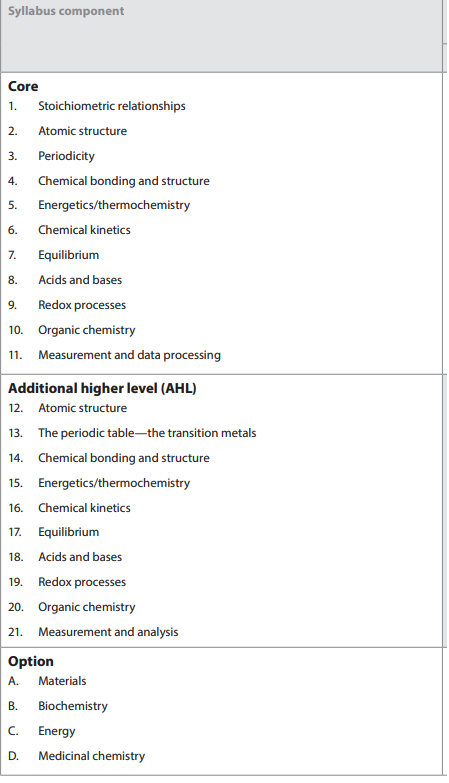
Students have access to an online textbook via Kognity, as well as several different reference books and revision guides that are accessible in the school library. 

Physics is the most fundamental of the experimental sciences, as it seeks to explain the universe itself from the very smallest particles—currently accepted as quarks, which may be truly fundamental—to the vast distances between galaxies. The result of physics to most of our students is our ability to change the world. This is the technological side of physics, in which physical principles have been applied to construct and alter the material world to suit our needs, and have had a profound influence on the daily lives of all human beings. Physics is therefore, above all, a human activity, and students need to be aware of the context in which physicists work.

The course is available at both standard level (SL) and higher level (HL).

Both theory and experiments are undertaken by students. The Diploma Programme chemistry course allows students to develop traditional practical skills and techniques and to increase facility in the use of mathematics. It also allows students to develop interpersonal skills, and digital technology skills, which are essential in 21st century scientific endeavour and are important life-enhancing, transferable skills in their own right.

Main aims of IB Physics:

The aims enable students, through the overarching theme of the Nature of science, to:

  •  Appreciate scientific study and creativity within a global context through stimulating and challenging opportunities
  •  Acquire a body of knowledge, methods and techniques that characterize science and technology
  •  Apply and use a body of knowledge, methods and techniques that characterize science and technology
  •  Develop an ability to analyse, evaluate and synthesize scientific information
  •  Develop a critical awareness of the need for, and the value of, effective collaboration and communication during scientific activities
  •  Develop experimental and investigative scientific skills including the use of current technologies
  •  Develop and apply 21st-century communication skills in the study of science
  •  Become critically aware, as global citizens, of the ethical implications of using science and technology
  •  Develop an appreciation of the possibilities and limitations of science and technology
  •  Develop an understanding of the relationships between scientific disciplines and their influence on other areas of knowledge. 

Main Objectives Physics:

The assessment objectives for biology, chemistry and physics reflect those parts of the aims that will be formally assessed either internally or externally. These assessments will centre upon the nature of science. It is the intention of these courses that students are able to fullfill the following assessment objectives:

  •  Demonstrate knowledge and understanding of:
  •  Facts, concepts and terminology
  •  Methodologies and techniques
  •  Communicating scientific information.
  •  Apply:
  •  Facts, concepts and terminology
  •  Methodologies and techniques
  •  Methods of communicating scientific information.
  •  Formulate, analyse and evaluate:
  •  Hypotheses, research questions and predictions
  •  Methodologies and techniques
  •  Primary and secondary data
  •  Scientific explanations.
  •  Demonstrate the appropriate research, experimental, and personal skills necessary to carry out insightful and ethical investigations.

The systems approach provides the core methodology of the Environmental Systems and Societies (ESS) course. It is complemented by other influences, such as economic, historical, cultural, socio-political, and scientific factors, to provide a holistic perspective on environmental issues. During the course, students will look at examples on a variety of scales, from local to global, and in an international context. 

Main aims of ESS

The aims of the ESS course are to enable students to: 

  1. Acquire the knowledge and understandings of environmental systems at a variety of scales 
  2. Apply the knowledge, methodologies, and skills to analyze environmental systems and issues at a variety of scales 
  3. Appreciate the dynamic interconnectedness between environmental systems and societies 
  4. Value the combination of personal, local, and global perspectives in making informed decisions and taking responsible actions on environmental issues 
  5. Be critically aware that resources are finite, and that these could be inequitably distributed and exploited, and that management of these inequities is the key to sustainability 
  6. Develop awareness of the diversity of environmental value systems 
  7. Develop critical awareness that environmental problems are caused and solved by decisions made by individuals and societies that are based on different areas of knowledge 
  8. Engage with the controversies that surround a variety of environmental issues 
  9. Create innovative solutions to environmental issues by engaging actively in local and global contexts. 

Below is the list of topics that students will be taught over a course of two academic years.

Topic 1— Foundations of environmental systems and societies 

Topic 2—Ecosystems and ecology 

Topic 3—Biodiversity and conservation 

Topic 4—Water and aquatic food production systems and societies 

Topic 5—Soil systems and terrestrial food production systems and societies 

Topic 6—Atmospheric systems and societies 

Topic 7—Climate change and energy production 

Topic 8—Human systems and resource use

Although the ESS course requires the study of environmental systems and societies at a range of scales, from local to global, the teaching of the course should be firmly grounded in the local environment. The syllabus contains many references to “local examples”, and fieldwork may be based on local ecosystems. On a broader scale, the course also leads students to an appreciation of the nature of the international dimension of ESS, since the resolution of the major environmental issues rests heavily upon international relationships and agreements.

Students will be taught over 2 academic years, with 3 hours of teaching per week, as well as homework time.

The tuition will involve the following

  • Tutorial lessons
  • Laboratory based activities
  • Field work
  • Group-based and peer learning
  • Presentation giving
  • Self study*

*Self study will make up a more substantial part of the work than most students are familiar with and students are expected to develop these skills as the course progresses.

ESS offered at STANDARD LEVEL 

Environmental Systems and Societies is a Standard Level course: there is no option to study it at Higher Level for the moment. It must not be assumed that this is therefore an “easy option” on the IB Diploma Programme. The course is multidisciplinary and is comprised of subject knowledge that will be entirely unfamiliar in some places to many students. The course is appropriately challenging, and therefore very rewarding, but must be approached with a conscientious attitude as with any course on the IB Diploma Programme.

Sports, exercise and health science Sports, exercise and health science (SEHS) is an experimental science that combines academic study with the acquisition of practical and investigative skills. It is an applied science course within group 4, with aspects of biological and physical science being studied in the specific context of sports, exercise and health. Moreover, the subject matter goes beyond the traditional science subjects to offer a deeper understanding of the issues related to sports, exercise and health in the 21st century. Apart from being worthy of study in its own right, SEHS is a good preparation for courses in higher or further education related to sports fitness and health, and serves as useful preparation for employment in sports and leisure industries.

Aims

It is in this context that the Diploma Programme sports, exercise and health science course should aim to:

  • Appreciate scientific study and creativity within a global context through stimulating and challenging opportunities
  • Acquire and apply a body of knowledge, methods and techniques that characterize science and technology
  • Develop an ability to analyse, evaluate and synthesize scientific information
  • Develop a critical awareness of the value of effective collaboration and communication during scientific activities
  • Develop experimental and investigative scientific skills including the use of current technologies
  • Develop and apply 21st-century information and communication skills
  • Become critically aware, as global citizens, of the ethical implications of using science and technology
  • Develop an appreciation of the possibilities and limitations of science and technology
  • Develop an understanding of the relationships between scientific disciplines.

Objectives

It is the intention of the Diploma Programme sports exercise and health science course that students achieve the following objectives.

  •  Demonstrate knowledge and understanding of:
  •  Facts, concepts and terminology
  •  Methodologies and techniques
  •  Communicating scientific information.

 Apply:

  •  Facts, concepts and terminology
  •  Methodologies and techniques
  •  Methods of communicating scientific information.
  •  Formulate, analyse and evaluate:
  •  Hypotheses, research questions and predictions
  •  Methodologies and techniques
  •  Primary and secondary data
  •  Scientific explanations.
  •  Demonstrate the appropriate research, experimental and personal skills necessary to carry out insightful and ethical investigations.

Computer Science is regarded as an experimental science, alongside biology, chemistry, design technology, physics and environmental systems and societies – and sits in the Group 4 list of subjects. The IB Computer Science course is a rigorous and practical problem-solving discipline. The IB DP computer science course requires an understanding of the fundamental concepts of computational thinking as well as knowledge of how computers and other digital devices operate. The course, underpinned by conceptual thinking, draws on a wide spectrum of knowledge, and enables and empowers innovation, exploration and the acquisition of further knowledge. Students study how computer science interacts with and influences cultures, society and how individuals and societies behave, and the ethical issues involved. During the course the student will develop computational solutions.

Main aims

Main aims of IBDP Computer Science:

  • Provide opportunities for study and creativity within a global context that will stimulate and challenge students developing the skills necessary for independent and lifelong learning. 
  • Provide a body of knowledge, methods and techniques that characterize computer science. 
  • Enable students to apply and use a body of knowledge, methods and techniques that characterize computer science. 
  • Demonstrate initiative in applying thinking skills critically to identify and resolve complex problems. 
  • Engender an awareness of the need for, and the value of, effective collaboration and communication in resolving complex problems. 
  • Develop logical and critical thinking as well as experimental, investigative and problem-solving skills. 
  • Develop and apply the students’ information and communication technology skills in the study of computer science to communicate information confidently and effectively. 
  • Encourage an understanding of the relationships between scientific disciplines and the overarching nature of the scientific method.

Main Objectives of Computer Science

During the course the student will develop computational solutions. This will involve the ability to:

  • Identify a problem or unanswered question.
  • Design, prototype and test a proposed solution. 
  • Liaise with clients to evaluate the success of the proposed solution and make recommendations for future developments.

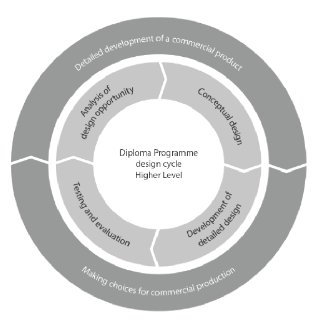
The IB Diploma Programme design technology aims to develop internationally minded people whose enhanced understanding of design and the technological world can facilitate our shared guardianship of the planet and create a better world. It focuses on analysis, design development, synthesis and evaluation. It requires the use of the design cycle as a tool, which provides the methodology used to structure the inquiry and analysis of problems, the development of feasible solutions, and the testing and evaluation of the solution. The solution can be defined as a model, prototype, product or system that students have developed independently.

Main aims

  • Analysis of a design opportunity.
  • Conceptual design.
  • Development of a detailed design.
  • Testing and evaluation.

For HL only

  • Detailed development of a commercial product.
  • Making choices for commercial production.

Main Objectives of IBDP Design Technology

Core areas:

The design technology syllabus at SL and HL consists of four equal interrelated areas, where at HL consist of two more added.

These core areas, which have been designed to fully interlink with the assessment tasks, are central to the design of the programme. Students are required to understand the relationship between these areas and how each area informs and impacts their work in design and technology. Each and every designer approaches a problem in a different way. Depending on the designers’ specialism, they tend to have their own methodology, but there are some general activities common to all designers. The design cycle model is a fundamental concept underpinning the design process and central to a student’s understanding of design activities. The student must take his or her invention and plan to develop it into an innovation, that is get the product to diffuse into the marketplace. The two new stages are designed to extend the students’ skills and ability to create innovations.

There are two courses available at DP level, each available at SL and HL.  These two courses might approach mathematics from different perspectives, but they are connected by the same mathematical body of knowledge, ways of thinking and approaches to problems. The differences in the courses may also be related to the types of tools, for instance technology, that are used to solve abstract or practical problems. 

These courses are designed for different types of students: 

  • Those who wish to study mathematics as a subject in its own right or to pursue their interests in areas related to mathematics, and 
  • Those who wish to gain understanding and competence in how mathematics relates to the real world and to other subjects. 

Each course is designed to meet the needs of a particular group of students.

AIMS

The aims of all DP mathematics courses are to enable students to: 

  • Develop a curiosity and enjoyment of mathematics and appreciate its elegance and power.
  • Develop an understanding of the concepts, principles, and nature of mathematics
  • communicate mathematics clearly, concisely, and confidently in a variety of contexts
  • Develop logical and creative thinking, and patience and persistence in problem solving to instil confidence in using mathematics 
  • Employ and refine their powers of abstraction and generalization
  • Take action to apply and transfer skills to alternative situations, to other areas of knowledge and to future developments in their local and global communities 
  • Appreciate how developments in technology and mathematics influence each other 
  • Appreciate the moral, social and ethical questions arising from the work of mathematicians and the applications of mathematics 
  • Appreciate the universality of mathematics and its multicultural, international and historical perspectives 
  • Appreciate the contribution of mathematics to other disciplines, and as a particular “area of knowledge” in the TOK course 
  • Develop the ability to reflect critically upon their own work and the work of others 
  • Independently and collaboratively extend their understanding of mathematics.

OBJECTIVES

Problem solving is central to learning mathematics and involves the acquisition of mathematical skills and concepts in a wide range of situations, including non-routine, open-ended and real-world problems. Having followed a DP mathematics course, students will be expected to demonstrate the following: 

  •  Knowledge and understanding: Recall, select and use their knowledge of mathematical facts, concepts and techniques in a variety of familiar and unfamiliar contexts. 
  •  Problem solving: Recall, select and use their knowledge of mathematical skills, results and models in both abstract and real-world contexts to solve problems. 
  •  Communication and interpretation: Transform common realistic contexts into mathematics; comment on the context; sketch or draw mathematical diagrams, graphs or constructions both on paper and using technology; record methods, solutions and conclusions using standardized notation; use appropriate notation and terminology. 
  •  Technology: Use technology accurately, appropriately and efficiently both to explore new ideas and to solve problems. 
  •  Reasoning: Construct mathematical arguments through use of precise statements, logical deduction and inference and by the manipulation of mathematical expressions. 
  •  Inquiry approaches: Investigate unfamiliar situations, both abstract and from the real world, involving organizing and analysing information, making conjectures, drawing conclusions, and testing their validity.

Structure of the course

Students will be studying the following units over 2 academic years:

  • Number and Algebra, 
  • Functions, 
  • Geometry and Trigonometry, 
  • Statistics and Probability and 
  • Calculus.  

They will also need to work on a Mathematics exploration which is like a research paper of around 3000 words which they need to write about a topic of their choice.   

Theory of knowledge questions usually accompany the lessons, and they enable students to think deeply about the matter.  The questions look like the following: Should Mathematics be defined as a language?  Is there a distinction between truth and certainty in Mathematics?

Mathematics: analysis and approaches

The IB DP Mathematics: analysis and approaches course recognizes the need for analytical expertise in a world where innovation is increasingly dependent on a deep understanding of mathematics. The focus is on developing important mathematical concepts in a comprehensible, coherent and rigorous way, achieved by a carefully balanced approach. 

Students are encouraged to apply their mathematical knowledge to solve abstract problems as well as those set in a variety of meaningful contexts. Mathematics: analysis and approaches has a strong emphasis on the ability to construct, communicate and justify correct mathematical arguments.

Students should expect to develop insight into mathematical form and structure, and should be intellectually equipped to appreciate the links between concepts in different topic areas. Students are also encouraged to develop the skills needed to continue their mathematical growth in other learning environments. 

The internally assessed exploration allows students to develop independence in mathematical learning. Throughout the course students are encouraged to take a considered approach to various mathematical activities and to explore different mathematical ideas.

 Assessment at a glance

Assessment – SL

External assessment (3 hours)

 Paper 1 (90 minutes) No technology allowed. (80 marks)

 Section A Compulsory short-response questions based on the syllabus. 

 Section B Compulsory extended-response questions based on the syllabus

Paper 2 (90 minutes) Technology required. (80 marks) 

Section A Compulsory short-response questions based on the syllabus. 

Section B Compulsory extended-response questions based on the syllabus

Internal assessment

This component is internally assessed by the teacher and externally moderated by the IB at the end of the course. Mathematical exploration Internal assessment in mathematics is an individual exploration. This is a piece of written work that involves investigating an area of mathematics. (20 marks)

Assessment – HL

External assessment (5 hours) 

Paper 1 (120 minutes) No technology allowed. (110 marks)

Section A Compulsory short-response questions based on the syllabus. 

Section B Compulsory extended-response questions based on the syllabus

Paper 2 (120 minutes) Technology required. (110 marks)

Section A Compulsory short-response questions based on the syllabus. 

Section B Compulsory extended-response questions based on the syllabus. 

Paper 3 (60 minutes) Technology required. (55 marks) 

Two compulsory extended response problem-solving question

Internal assessment 

This component is internally assessed by the teacher and externally moderated by the IB at the end of the course. Mathematical exploration Internal assessment in mathematics is an individual exploration. This is a piece of written work that involves investigating an area of mathematics. (20 marks)

There are two courses available at DP level, each available at SL and HL.  These two courses might approach mathematics from different perspectives, but they are connected by the same mathematical body of knowledge, ways of thinking and approaches to problems. The differences in the courses may also be related to the types of tools, for instance technology, that are used to solve abstract or practical problems. 

These courses are designed for different types of students: 

  • Those who wish to study mathematics as a subject in its own right or to pursue their interests in areas related to mathematics, and 
  • Those who wish to gain understanding and competence in how mathematics relates to the real world and to other subjects. 

Each course is designed to meet the needs of a particular group of students.

AIMS

The aims of all DP mathematics courses are to enable students to: 

  • Develop a curiosity and enjoyment of mathematics and appreciate its elegance and power.
  • Develop an understanding of the concepts, principles, and nature of mathematics
  • Communicate mathematics clearly, concisely, and confidently in a variety of contexts
  • Develop logical and creative thinking, and patience and persistence in problem solving to instil confidence in using mathematics 
  •  Employ and refine their powers of abstraction and generalization
  • Take action to apply and transfer skills to alternative situations, to other areas of knowledge and to future developments in their local and global communities 
  • Appreciate how developments in technology and mathematics influence each other 
  • Appreciate the moral, social and ethical questions arising from the work of mathematicians and the applications of mathematics 
  • Appreciate the universality of mathematics and its multicultural, international and historical perspectives 
  • Appreciate the contribution of mathematics to other disciplines, and as a particular “area of knowledge” in the TOK course 
  • Develop the ability to reflect critically upon their own work and the work of others 
  • Independently and collaboratively extend their understanding of mathematics.

OBJECTIVES

Problem solving is central to learning mathematics and involves the acquisition of mathematical skills and concepts in a wide range of situations, including non-routine, open-ended and real-world problems. Having followed a DP mathematics course, students will be expected to demonstrate the following: 

  • Knowledge and understanding: Recall, select and use their knowledge of mathematical facts, concepts and techniques in a variety of familiar and unfamiliar contexts. 
  •  Problem solving: Recall, select and use their knowledge of mathematical skills, results and models in both abstract and real-world contexts to solve problems. 
  • Communication and interpretation: Transform common realistic contexts into mathematics; comment on the context; sketch or draw mathematical diagrams, graphs or constructions both on paper and using technology; record methods, solutions and conclusions using standardized notation; use appropriate notation and terminology. 
  • Technology: Use technology accurately, appropriately and efficiently both to explore new ideas and to solve problems. 
  • Reasoning: Construct mathematical arguments through use of precise statements, logical deduction and inference and by the manipulation of mathematical expressions. 
  • Inquiry approaches: Investigate unfamiliar situations, both abstract and from the real world, involving organizing and analysing information, making conjectures, drawing conclusions, and testing their validity.

Structure of the course

Students will be studying the following units over 2 academic years:

  • Number and Algebra, 
  • Functions, 
  • Geometry and Trigonometry, 
  • Statistics and Probability and 
  • Calculus.  

They will also need to work on a Mathematics exploration which is like a research paper of around 3000 words which they need to write about a topic of their choice.   

Theory of knowledge questions usually accompany the lessons, and they enable students to think deeply about the matter.  The questions look like the following: Should Mathematics be defined as a language?  Is there a distinction between truth and certainty in Mathematics?

Mathematics: applications and interpretation

The IB DP Mathematics: applications and interpretation course recognizes the increasing role that mathematics and technology play in a diverse range of fields in a data-rich world. As such, it emphasizes the meaning of mathematics in context by focusing on topics that are often used as applications or in mathematical modelling. 

To give this understanding a firm base, this course includes topics that are traditionally part of a pre-university mathematics course such as calculus and statistics. Students are encouraged to solve real-world problems, construct and communicate this mathematically and interpret the conclusions or generalizations. 

Students should expect to develop strong technology skills, and will be intellectually equipped to appreciate the links between the theoretical and the practical concepts in mathematics. 

All external assessments involve the use of technology. Students are also encouraged to develop the skills needed to continue their mathematical growth in other learning environments. 

The internally assessed exploration allows students to develop independence in mathematical learning. Throughout the course students are encouraged to take a considered approach to various mathematical activities and to explore different mathematical ideas.

Assessment at a glance

Assessment – SL

External assessment (3 hours)

Paper 1 (90 minutes) Technology required. (80 marks) 

Compulsory short-response questions based on the syllabus. (80 marks)

Paper 2 (90 minutes) Technology required. (80 marks)

 Compulsory extended-response questions based on the syllabus. (80 marks)

Internal assessment 

This component is internally assessed by the teacher and externally moderated by the IB at the end of the course. 

Mathematical exploration 

Internal assessment in mathematics is an individual exploration. This is a piece of written work that involves investigating an area of mathematics. (20 marks)

Assessment – HL

External assessment (5 hours) 

Paper 1 (120 minutes) Technology required. (110 marks)
 Compulsory short-response questions based on the syllabus.

Paper 2 (120 minutes) Technology required. (110 marks) 
Compulsory extended-response questions based on the syllabus.

Paper 3 (60 minutes) Technology required. (55 marks) 
Two compulsory extended response problem-solving questions.

Internal assessment 
This component is internally assessed by the teacher and externally moderated by the IB at the end of the course. 

Mathematical exploration 
Internal assessment in mathematics is an individual exploration. This is a piece of written work that involves investigating an area of mathematics. (20 marks)

The goals of International Baccalaureate (IB) Visual Arts are for students to explore and critically respond to: the aesthetic qualities of visual arts, the relationship between form and meaning, the social and cultural functions of visual arts, and the socio-cultural and historical contexts of other cultures. This course of study has both a studio and an investigation component.

Students are required to maintain a visual arts journal, which serves as documentation of the evolution of their aesthetic and creative journey. Students develop skills in investigation, inquiry, organization, critical thinking, problem solving, time management, reflection, and life-long scholarship.

The course of study is intended to enable students to study Visual Arts in a personally meaningful way and to promote the study of Visual Arts in higher education. However, the course of study also supports students who are interested in life-enriching experiences by investigating and creating art.

Students will embark upon a journey of creative exploration and discovery, which will include three equal and interrelated areas: visual arts in context, visual arts methods, and communicating visual arts.

Aims of IB Visual Arts

The aims are to enable students to develop:

  • An ability to record from direct observation and personal experience
  • An ability to identify and solve problems in visual and/or other forms
  • Creativity, visual awareness, critical and cultural understanding
  • An imaginative, creative and personal response
  • Confidence, enthusiasm and a sense of achievement in the practice of art and design
  • Growing independence in the refinement and development of ideas and personal outcomes
  • Engagement and experimentation with a range of media, materials and techniques, including new media and technologies, where appropriate
  • Experience of working in relevant frameworks and exploration of manipulative skills necessary to form, compose and communicate in two and/or three dimensions
  • A working vocabulary relevant to the subject and an interest in, and a critical awareness of, other practitioners, environments and cultures
  • Investigative, analytical, experimental, interpretative, practical, technical and expressive skills which aid effective and independent learning.

Objectives of IB Visual Arts

Having followed the visual arts course at HL or SL, students will be expected to:

  • Respond to and analyze critically and contextually the function, meaning and artistic qualities of past, present and emerging art, using the specialist vocabulary of visual arts
  • Develop and present independent ideas and practice, and explain the connections between these and the work of others
  • Explore and develop ideas and techniques for studio work through integrated contextual study and first-hand observations
  • Develop and maintain a close relationship between investigation and a purposeful, creative process in studio work
  • Produce personally relevant works of art that reveal evidence of exploration of ideas that reflect cultural and historical awareness
  • Develop and demonstrate technical competence and artistic qualities that challenge and extend personal boundaries

The IB Diploma Programme theatre course is a multifaceted theatre-making course of study. It gives students the opportunity to make theatre as creators, designers, directors and performers. It emphasizes the importance of working both individually and collaboratively as part of an ensemble. It offers the opportunity to engage actively in the creative process, transforming ideas into action as inquisitive and productive artists. (IBO Theatre Guide)

Main aims of IBDP Theatre

The aims of the theatre course at SL and HL are to enable students to:

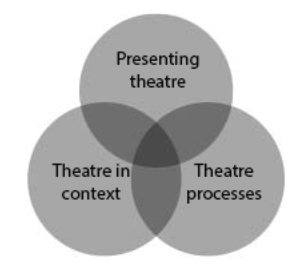
  • Explore theatre in a variety of contexts and understand how these contexts inform practice (theatre in context)
  • Understand and engage in the processes of transforming ideas into action (theatre processes)
  • Develop and apply theatre production, presentation and performance skills, working both independently and collaboratively (presenting theatre)

For HL only:

Understand and appreciate the relationship between theory and practice (theatre in context, theatre processes, presenting theatre).

Main Objectives of IBDP Theatre

Core areas

The theatre syllabus at SL and HL consists of three equal, interrelated areas:

These core areas, which have been designed to fully interlink with the assessment tasks, are central to the design of the programme. Students are required to understand the relationship between these areas and how each area informs and impacts their work in theatre. Students are required to approach these areas from the perspectives of each of the following specialist theatre roles:

  • Creator
  • Designer
  • Director
  • Performer.

The course covers a culturally diverse range of play texts, theatre traditions and theatre practitioners including Wole Soyinka. Bertolt Brecht and Japanese Noh Theatre.

The TOK course provides students with an opportunity to explore and reflect on the nature of knowledge and the process of knowing. In TOK, students reflect on the knowledge, beliefs and opinions that they have built up from their years of academic studies and their lives outside the classroom. The course is intended to be challenging and thought-provoking—as well as empowering—for students.

The course centres on the exploration of knowledge questions, which are a key tool for both teachers and students. These are contestable questions about knowledge itself, such as: “What counts as good evidence for a claim?”, “Are some types of knowledge less open to interpretation than others?”, or “What constraints should there be on the pursuit of knowledge?”. 

The following 12 concepts have particular prominence within, and thread throughout, the TOK course: evidence, certainty, truth, interpretation, power, justification, explanation, objectivity, perspective, culture, values and responsibility. Exploration of the relationship between knowledge and these concepts can help students to deepen their understanding, as well as facilitating the transfer of their learning to new and different contexts.

Aims of the subject

  • To encourage students to reflect on the central question, “How do we know that?”, and to recognize the value of asking that question 
  • To expose students to ambiguity, uncertainty and questions with multiple plausible answers 
  • To equip students to effectively navigate and make sense of the world, and help prepare them to encounter novel and complex situations 
  • To encourage students to be more aware of their own perspectives and to reflect critically on their own beliefs and assumptions 
  • To engage students with multiple perspectives, foster open-mindedness and develop intercultural understanding 
  • To encourage students to make connections between academic disciplines by exploring underlying concepts and by identifying similarities and differences in the methods of inquiry used in different areas of knowledge 
  • To prompt students to consider the importance of values, responsibilities and ethical concerns relating to the production, acquisition, application and communication of knowledge.

Objectives of the subject

Having completed the TOK course, students should be able to: 

  • Demonstrate TOK thinking through the critical examination of knowledge questions 
  • Identify and explore links between knowledge questions and the world around us 
  • Identify and explore links between knowledge questions and areas of knowledge 
  • Develop relevant, clear and coherent arguments 
  • Use examples and evidence effectively to support a discussion 
  • Demonstrate awareness and evaluation of different points of view 
  • Consider the implications of arguments and conclusions.


Topics taught: Years 12 to 13

Core theme: Knowledge and the knower 

The core theme—knowledge and the knower—provides an opportunity for students to reflect on what shapes their perspective as a knower, where their values come from, and how they make sense of, and navigate, the world around them.

Knowledge and technology 

For many, advances in technology have provided easy access to massive amounts of data and information, and have facilitated unprecedented levels of global interaction. However, they have also raised important questions about how we engage with, and understand, information; about our understanding of the world; and about our understanding of ourselves. This optional theme focuses on issues relating to the impact of technology on knowledge and knowers, and how technology helps and hinders our pursuit of knowledge. It examines the ways that technology can be seen to shape knowledge creation, knowledge sharing and exchange, and even the nature of knowledge itself.

Knowledge and language 

Language is an essential part of our daily lives, with most of our knowledge coming to us linguistically encoded. It plays an important role in communicating and sharing knowledge and has a significant impact on the way that we experience the world. However, some see language as having an even more central role, arguing that language doesn’t just describe our experiences of the world but, in fact, actually structures those experiences, limiting and shaping what we know.

Knowledge and politics 

Knowledge itself has an intrinsically political dimension, as questions about how knowledge is constructed, used and disseminated are infused with issues relating to power and politics. Political issues and decisions also affect our daily lives in many different ways. This theme provides an opportunity for discussions about the practice of politics and our everyday interactions with politics in the world around us.

Areas of Knowledge

Areas of knowledge are structures within which much human knowledge is organized. In these areas there are often socially established methods for producing knowledge, as well as norms for what counts as a fact or a good explanation. Students will look at how knowledge is acquired and created in the following five Areas of Knowledge:

  • History 
  • The human sciences 
  • The natural sciences 
  • The arts 
  • Mathematics 

Within their discussions, students are encouraged to think about, and draw examples from, specific individual academic disciplines that are included within the different areas of knowledge.

The Extended Essay is a 4,000-word research project. It is an essential part of the IB Diploma Program and prepares students for undergraduate research. It also gives students the opportunity to work independently on a research topic that is of interest to them and that may help to support their university application to a course they want to study. During the Extended Essay process a student further develops skills in researching, referencing, analysing, evaluating, and reflecting. These are just some of the additional learning skills that will help across all aspects of academic life, and in future careers.

Creativity, Activity, Service (CAS) is a core part of the IB Diploma and provides an excellent structure for the co-curricular and community service elements of life at Northfields International School, as well as supporting our pastoral mission to develop the whole person. Students design their own CAS program in both phases of the school but must challenge themselves.

The CAS Philosophy and Aims

CAS enables and inspires each student to develop a spirit of discovery and initiative that has real benefits and consequences.  It asks the student to challenge themselves, stretch beyond their personal limits, and share their talents and energies with others in their local, national, and global communities.

The CAS requirement encourages students to discover new skills and interests and develop a sense of responsibility and personal commitment to doing what they can to improve the world around them and increase the well-being of others.  It prepares students to participate in and contribute to the international community by fostering the development of values and attitudes that transcend issues of politics, religion, class, race, and gender.  In short, CAS is designed to aid students in becoming more active and committed citizens as well as future leaders working to create a better world.

CAS at Northfields

The IBO and   Northfields International School require that students in Years 12 and 13 complete the following strands of creativity, activity, and service from September of the first year DP1 of the program until the end of March in DP2 the second year. This important requirement for IB fosters experiential learning beyond the confines of the classroom by encouraging students to become involved in creative pursuits, physical activities, and local, national, and international projects.

CAS enables and inspires each student to develop a spirit of discovery and initiative that has real benefits and consequences.  It asks the student to challenge themselves, to stretch beyond their personal limits, and share their talents and energies with others in their local, national, and global communities.

The CAS requirement encourages students to discover new skills and interests and develop a sense of responsibility and personal commitment to doing what they can to improve the world around them and increase the well-being of others. At Northfields, our students are exposed to various opportunities that shape their CAS, such as getting involved in different cultural activities, promoting awareness such as Movember, working alongside local NGOs, and many more.

In short, CAS is designed to aid students in becoming more active and committed citizens as well as future leaders working to create a better world.

Come and Visit Northfields


We'd love to welcome you to our campus at Labourdonnais Village, Mapou.